
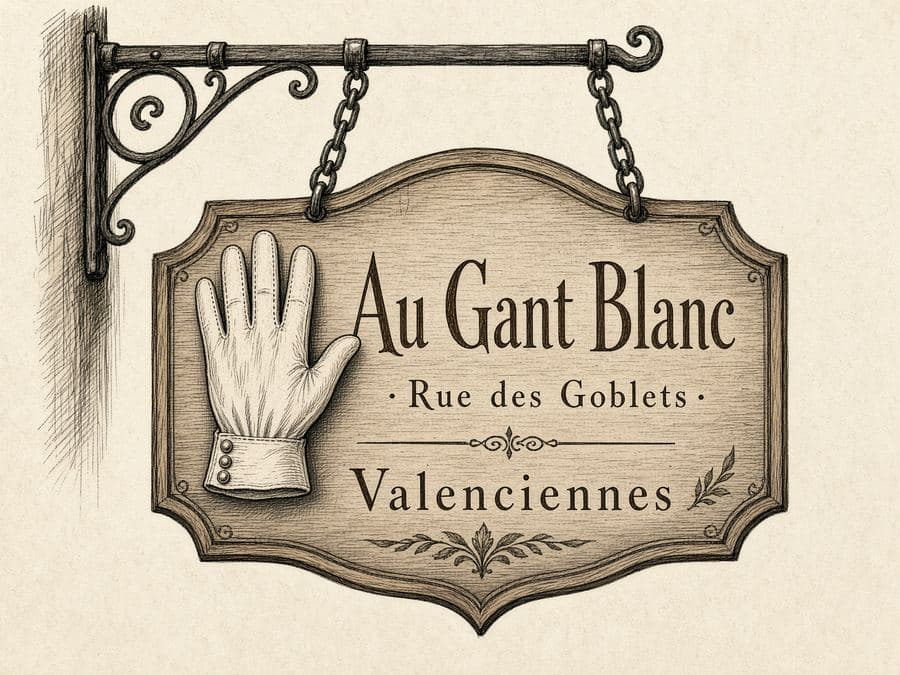
Why we’re called White Glove
In the early 1700s, a tavern keeper named Michel Le Borne ran a cabaret in Valenciennes, in northern France, under the sign of the White Glove: au Gant Blanc, rue des Goblets.
We found him the way we find everyone: one handwritten line at a time. The parish clerk who buried his wife in 1707 wrote “au blan gand rue des gobletz.” When Michel was buried in January 1712, the clerk wrote “Blan Gand” again. His son Jacques Antoine had already grown up in that tavern. In 1718 he sailed from La Rochelle to Louisiana and started a family that is still there three hundred years later.
Our founder descends from that family. Tracing Michel back through French and Belgian archives, register by register, is the work that started this company, and it’s still going: in 2026 the trail led from Valenciennes to Cambrai, where Michel married and his first children were baptized. We named the company after his tavern because that sign is where our own story begins, and because “white glove” already means what we promise: careful, patient handling of something irreplaceable.
Why we do this
Every family has someone who disappears from the record: an immigrant who never said where he came from, a grandmother whose maiden name nobody wrote down, a line that stops cold in 1850. Those gaps don’t mean the answer is gone. Usually it’s sitting in a register nobody has read yet, in a language the family no longer speaks.
We love the moment a name turns up in the margin of a three-hundred-year-old page. We love it just as much when we can show a family exactly where the records end and why. Either way, you get the truth about your people, with the evidence to back it up.
A note for the archivists: we don’t actually wear white gloves to handle old paper. Clean, dry hands are better for it. The gloves are about how we treat your family’s story.
How we research
If a link in your tree isn’t proven, we say so. You’ll see it marked [?], with the evidence for and against.
Our research engine reads handwritten records in their original language. Every transcription is shown next to an image of the original page, readings we’re unsure of are marked [?], and every conclusion cites the record behind it, so you, or any genealogist, can check our work line by line.